
The most common complaint in break rooms, restaurants, and any building where people drink from the tap or where water goes into a product.
Commercial & Industrial
Chlorine Does Its Job Before It Reaches You
Commercial Dechlorinator Systems
Municipal water arrives with a chlorine residual on purpose. It keeps the distribution system safe between the treatment plant and your building. Once it reaches your facility, that residual becomes something you have to manage rather than something that helps you.
Flexible Sizing400+gallons per minute flow rate
RemovesCl₂ & NH₂Clchlorine adjusted to any level you need
RangePOU to whole-facilitytank sizes up to 48" diameter
★★★★★ 4.9 on Google Family-owned since 1973 Commercial installs since 1973
Why It Matters
Why Facilities Take Chlorine Out
Gordon Water Systems sizes and installs commercial dechlorinator systems across West Michigan, from point-of-use carbon filters feeding a coffee station to whole-facility backwashing carbon beds handling high flow.
Municipal water arrives with a disinfectant residual on purpose. It keeps the distribution system safe, and it should be taken out at your building, not in your product.
Where It Pays Off
Five reasons facilities take the disinfectant residual out before it reaches equipment, product, or people.
Free chlorine degrades thin-film composite membranes. Carbon ahead of the RO is what keeps that from happening.
Chlorine accelerates wear on elastomers, gaskets, and some metals in plumbing and equipment.
In brewing, food production, and beverage service, disinfectant residual carries through into what you sell.
Some manufacturing and laboratory processes will not tolerate an oxidizer in the feed water.
Before Sizing
Sizing Carbon for Chlorine
Carbon reduces chlorine by contact time. The most common sizing mistake we see is a bed that is too small for the flow going through it.
Step 1
Chlorine level
Municipal residuals vary by city and by season. We measure the free chlorine at your service entrance rather than assuming a number.
Step 2
Flow and contact time
Carbon needs enough contact with the water to work. We size the bed to your peak flow, not your average, so it keeps up when demand spikes.
Step 3
We test first
We confirm chlorine level and peak flow before sizing anything, and we check for sediment that would call for a backwashing system.
Result — sized to the right disinfectantA carbon bed sized too small for your flow breaks through early.We confirm your chlorine level and peak flow before we quote.
Talk to Our Team → Equipment Lineup
Systems We Install
Point-of-use carbon through whole-facility backwashing systems. Backwashing periodically reverses flow through the carbon bed to lift out sediment and re-stratify the media; without it a bed channels, and water finds a path around the carbon instead of through it.
Smallest unit
Low to mid volume
Model 1100
Coffee stations, ice machines, single-equipment feeds, small offices, and defined process loads.
Higher capacity
Larger facilities
Model 1175
Higher capacity for larger facilities and higher continuous flow. Same footprint and look as the 1100; the difference is capacity.
Non-electric
Backwashing carbon
Kinetico Backwashing Carbon
Non-electric, volume-triggered backwash. Same benefit as the non-electric softeners: no board to fail, and backwash initiated by water treated rather than by a timer.
Multi-tank
Backwashing carbon
Hellenbrand Backwashing Carbon
Electric control, available in multi-tank configurations including triplex for high flow applications. Also handles hydrogen sulfide odor reduction, which matters on well water.
Spec Sheet
How We Size a Dechlorinator
Six factors, in order of how often they get overlooked.
- 1. Bed contact time
- How long the water is in contact with the carbon. This is the number that determines whether the system works.
- 2. Chlorine level
- Free chlorine, and at what level.
- 3. Peak flow rate
- Contact time falls as flow rises, so the bed has to be sized for the worst case, not the average.
- 4. Water temperature
- Colder water reduces the rate of reaction at the carbon surface.
- 5. Single-process or whole-facility
- Feeding one machine is a different build from feeding a building.
- 6. Space, plumbing, and drain access
- Backwashing systems need a drain and adequate clearance.
Ongoing Care
Carbon Replacement and Service
Activated carbon has a finite capacity. It does not signal when it is spent, and a system that has stopped reducing chlorine looks and sounds exactly like one that is still working. That is why we test the treated water for chlorine on service visits and rebed when the test says so, not on a calendar or a calculation.
Carbon systems are sold, not rented or financed. Carbon life depends on your water and flow, so a rental with bed replacement built in would not be fair to either side.
Projects
Systems We've Installed
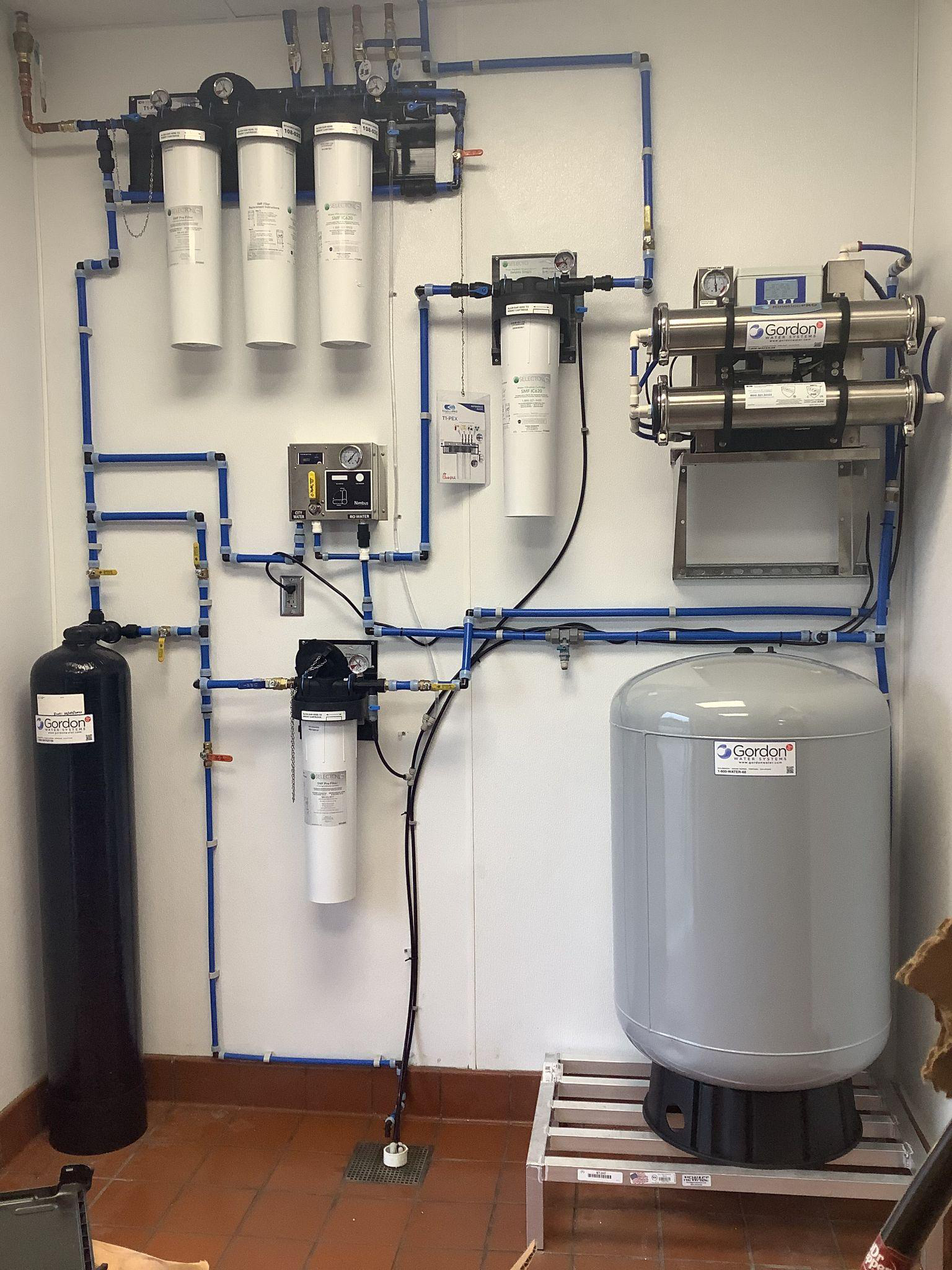
Chick-fil-AStandale, MI
The challengeA restaurant needed one system covering every drinking water application in the building: ice, dispensed water, and coffee. That meant chlorine reduction at several points of use plus high-purity reverse osmosis (RO) water feeding the coffee and steamer equipment.
The systemKinetico chlorine reduction system, a focused carbon filter build matched to the brand's equipment standards, and a Kinetico commercial RO designed for beverage service
The resultCleaner, safer drinking water across ice, water, and coffee.
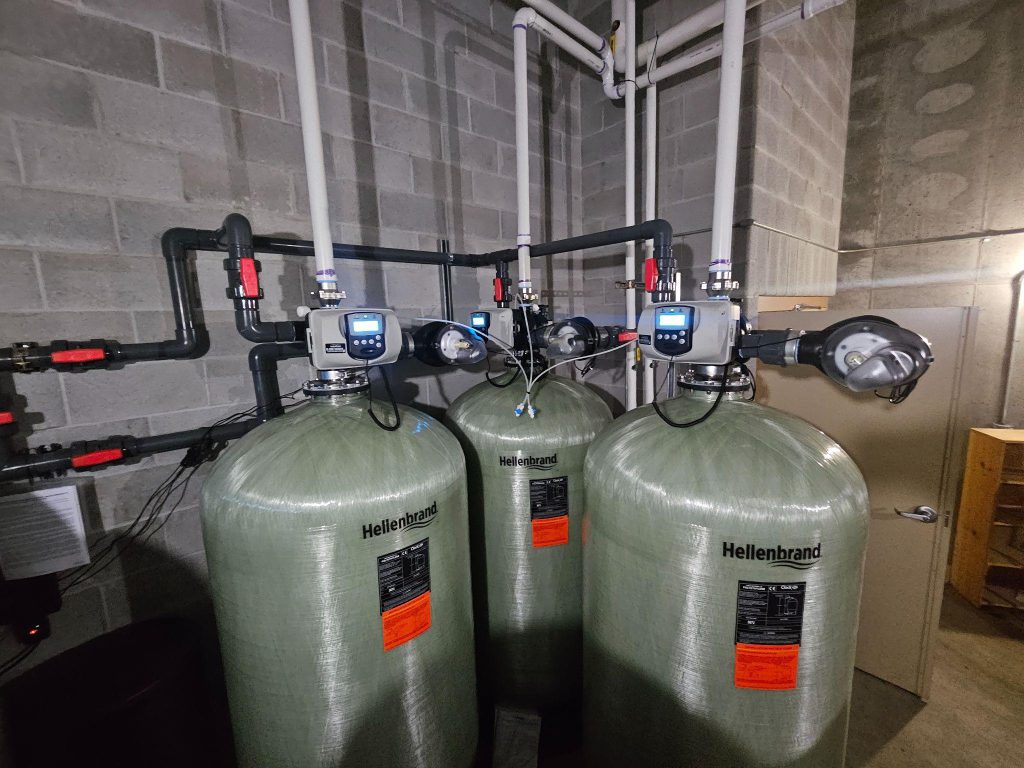
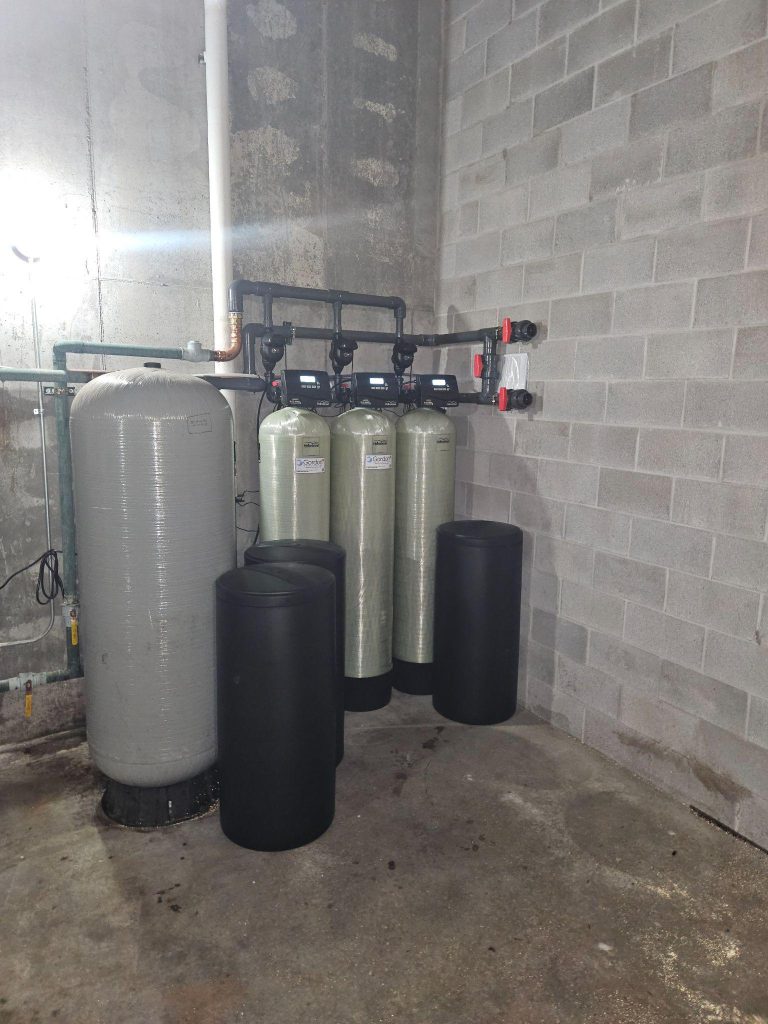
Blue Lake Fine Arts CampTwin Lake, MI
The challengeA large music camp wanted better tasting water with less odor for campers, plus soft water to a large kitchen. Hydrogen sulfide is a smell problem before it is anything else, and it is hardest to hold down at exactly the high flow rates a camp hits at mealtimes.
The systemHellenbrand H200 Triplex carbon backwashing system for sulfur odor reduction at high flow, paired with a Hellenbrand H125-96 Triplex progressive flow commercial water softener for continuous soft water across variable demand
The resultIn the camp's own words: campers and kitchen staff are happy.
More from Commercial & Industrial
Other Commercial Services
Most facilities need more than one of these. We size, install and service them together, on one schedule. See the full Commercial & Industrial overview.
Commercial Water Softeners
Single tank through triplex, electric and non-electric, from 3 GPM to 80 GPM and beyond.
Explore Commercial Water Softeners →Commercial Reverse Osmosis & High-Purity Water
Reverse osmosis and de-ionized water for beverage, boiler makeup, rinse, and process applications.
Explore Commercial Reverse Osmosis & High-Purity Water →Commercial Salt Delivery
DuraCube delivered to your tank, your dock, or ready for pickup at four West Michigan offices.
Explore Commercial Salt Delivery →Office & Workplace Drinking Water
Bottleless coolers, bottled delivery, and break room filtration on a route you set.
Explore Office & Workplace Drinking Water →Questions
Frequently Asked Questions
What does a commercial dechlorinator do?
It passes water through activated carbon, which reduces the chlorine residual the municipality adds to keep the distribution system safe. That reduction improves taste and odor, protects RO membranes, and slows corrosion of gaskets and components downstream.
How much carbon does it take to remove chlorine?
It depends on the chlorine level and, more than anything, the flow rate. Carbon works by contact time, so a bed that is too small for the peak flow lets chlorine through even though it seemed to work at low demand. We measure both before we size a system.
How do you size a dechlorinator?
The governing number is bed contact time, which is how long the water is in contact with the carbon. We work from chlorine level, peak flow rate, water temperature, whether you are feeding one process or the whole facility, and the space and drain access available.
What does backwashing do?
It periodically reverses flow through the carbon bed to lift out accumulated sediment and re-stratify the media. Without backwash, a bed channels over time and water finds a path around the carbon instead of through it, which means the system stops working while still appearing to run.
How often does the carbon need replacing?
Activated carbon has a finite capacity and gives no warning when it is spent. A system that has stopped reducing chlorine looks and sounds identical to one still working. We test the treated water for chlorine on service visits and rebed when the test shows breakthrough, rather than on a set interval.
Can a dechlorinator help with sulfur or rotten egg odor?
Yes. Backwashing carbon systems reduce hydrogen sulfide odor as well as chlorine, which is common on well water. Blue Lake Fine Arts Camp runs a Hellenbrand H200 Triplex carbon backwashing system for exactly that reason.
Do I need a dechlorinator if I already have a water softener?
They do different jobs. A softener addresses hardness. It does not reduce chlorine. Facilities that care about taste, protect RO equipment, or produce food and beverage typically run both.
No pressure, no obligation
Talk to Our Commercial Team
Point-of-use carbon through whole-facility backwashing systems, sized on contact time rather than a catalog number.
Free water test includedWe size your softener to your actual water.
Local install, minimal downtimeBackground-checked Gordon team, never a contractor.
Honest adviceRecommendations backed by science, not a sales script.
800-928-3768Or call or text, we’re a local, family-owned team



Who you'll hear fromBrad DeBoer, Jaran Malafa, Tom Duisterhof
Tell us about your facility
Sized on peak flow and your actual water, not a catalog number.